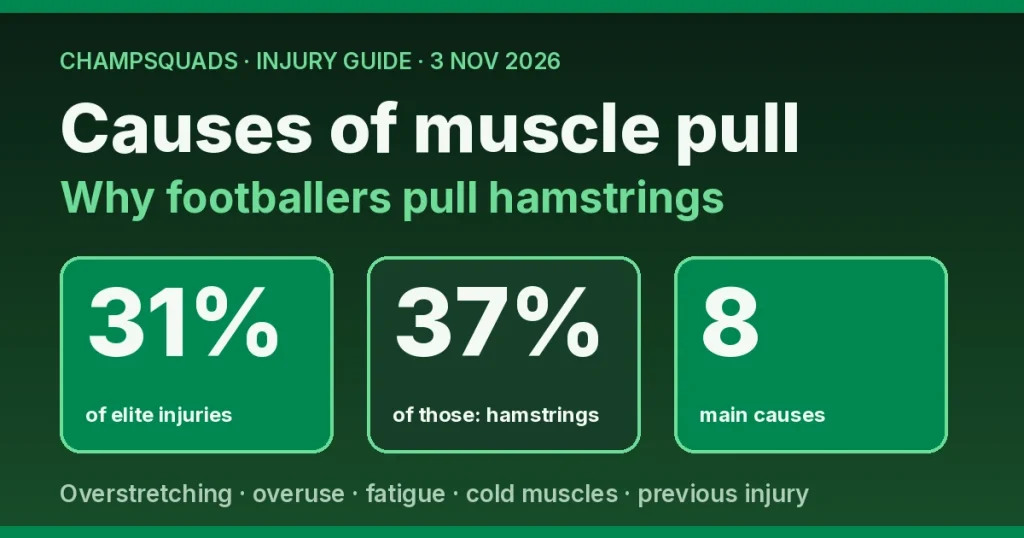
The causes of muscle pull come down to one thing: a muscle is asked to stretch or work harder than its fibres can handle, and some of them tear. For footballers that usually means a sprint, a stretch for the ball or a tired late burst. This guide explains what causes a muscle pull, which muscles are most at risk, and why the same names keep appearing on team-news lists.

What is a muscle pull?
A pulled muscle, or muscle strain, is damage to muscle fibres or the tendon that joins the muscle to bone. A sprain is different. The sprain meaning is an overstretched or torn ligament, the tissue linking bone to bone at a joint, such as a rolled ankle. The NHS groups the two together because the early care is similar, but the injured tissue is not the same.
So what is the difference between a torn muscle and a pulled muscle? Mostly degree. Doctors grade strains from 1 to 3. Grade 1 means a few fibres are overstretched, grade 2 a partial tear and grade 3 a complete tear, according to Cleveland Clinic. A footballer “pulling” a hamstring is usually grade 1 or 2, while a “torn” hamstring that needs surgery is grade 3 or a tendon injury.
Causes of muscle pull (muscle strain): the main triggers
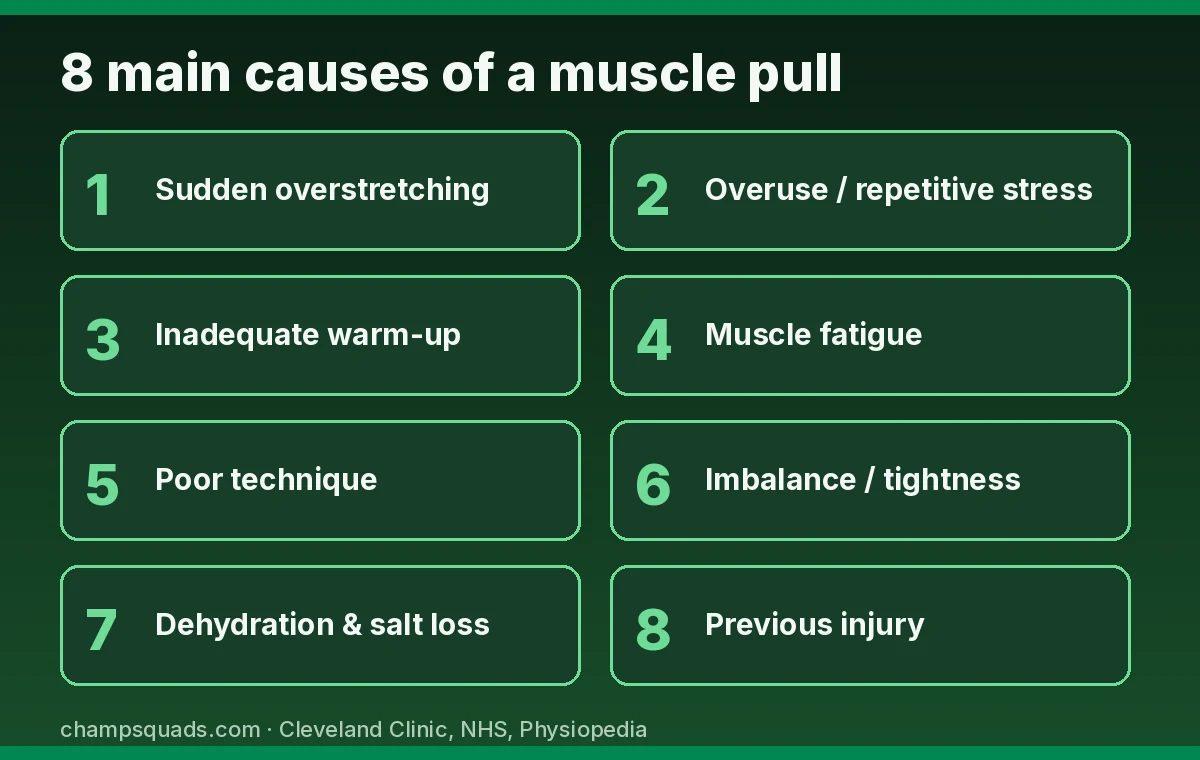
Quick answer: A muscle pull (muscle strain) occurs when muscle fibres are overstretched or torn. The most common causes are sudden overstretching, overuse, inadequate warm-up, muscle fatigue and poor technique.
| Cause | Explanation | Common situations |
|---|---|---|
| Sudden overstretching | The muscle is forced beyond its normal range, often while it is contracting | Sprinting, jumping, kicking, lunging for a tackle |
| Overuse / repetitive stress | Small micro-tears build up faster than the muscle can repair them | Running, lifting, congested fixture lists |
| Inadequate warm-up | Cold muscles are stiffer and less elastic | Starting intense activity cold, coming off the bench |
| Muscle fatigue | Tired muscles lose strength, coordination and shock absorption | Late in games or long sessions |
| Poor technique | Incorrect form puts extra load on one muscle | Bad lifting form, awkward landings |
| Muscle imbalance or tightness | Weak or tight muscles create uneven load between opposing groups | Strong quads with weak hamstrings, weak glutes |
| Dehydration and electrolyte loss | Fluid and salt losses are linked to cramp and early fatigue | Hot weather, heavy sweating |
| Previous injury | Scar tissue or incomplete rehab leaves a weaker spot | Returning too soon after a strain |
Acute vs chronic causes
Clinicians split strains into two types. Acute strains happen in a moment: explosive sprints, sudden changes of direction, heavy or awkward lifting, slips and falls, or a direct blow in a collision. The classic mechanism is eccentric loading, where a muscle is forced to lengthen while it is contracting hard. In a sprint, the hamstrings brake the swinging lower leg just before the foot lands, which Physiopedia identifies as the riskiest moment.
Chronic strains build up over weeks. Repetitive motion, overtraining without rest and prolonged awkward posture, such as hunching at a desk, slowly wear the fibres down until a normal movement is enough to cause pain.
Key risk factors
- Explosive movements: sprinting, jumping and sudden direction changes.
- Training when fatigued: tired muscles absorb less force.
- Rapid increases in load: a big jump in intensity or volume, such as pre-season or three games in a week.
- Cold weather or cold muscles: stiffer fibres tear more easily.
- Muscle imbalances: one group much stronger or tighter than its opposite, such as quadriceps versus hamstrings.
Commonly affected muscles
The hamstrings, quadriceps, calves, groin (adductors), lower back and shoulder muscles strain most often. In football the legs dominate. A UEFA-backed study by Ekstrand and colleagues found muscle injuries made up 31% of all time-loss injuries in elite clubs. Of these, 92% hit four groups: hamstrings (37%), adductors (23%), quadriceps (19%) and calves (13%).
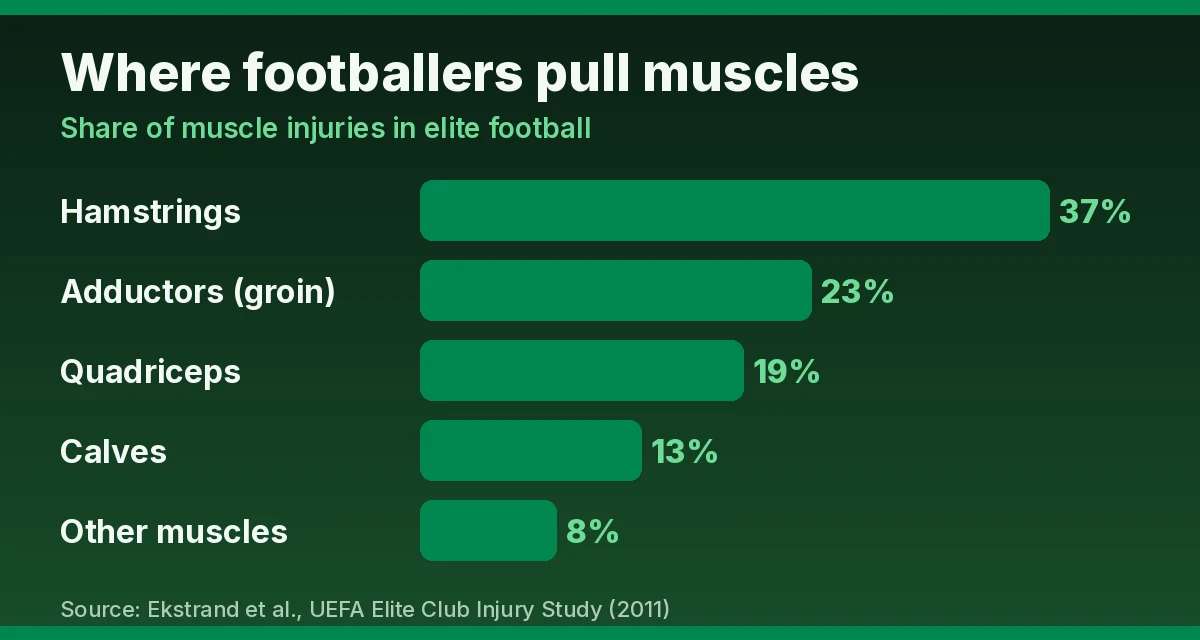
Based on standard sports medicine and orthopaedic understanding of muscle strains, with sources including Cleveland Clinic, the NHS, Physiopedia and the UEFA Elite Club Injury Study.
What causes muscle pull in the leg?
Most leg strains in football follow the patterns above. Hamstrings go during flat-out sprints, quads while striking a ball or sprinting, and calves during sudden push-offs, often late in games or on hard pitches. The same causes of muscle pull in legs apply to weekend players, with poor warm-up and fatigue at the top of the list.
Causes of muscle pull in the foot are usually overuse, worn or poorly fitting boots, and sudden push-offs on firm ground. Foot pain after a twist is just as likely to be a sprain or a stress injury, so it is worth getting checked.
At night, while sleeping and in pregnancy
The causes of muscle pull in the leg while sleeping are usually not a strain at all. That sudden tightening at night is normally a cramp. The NHS says the cause is often unknown, but cramps are linked to hard exercise, ageing, some medicines and pregnancy. That explains the causes of muscle pull at night during pregnancy, which are most common in later months. Gentle calf stretches before bed may help, but frequent cramps, swelling or one painful, hot leg in pregnancy need a midwife or doctor straight away.
Famous footballers and their muscle injuries
Players at the very top get every advantage, from GPS monitoring to daily physio, and they still pull muscles. Recent examples show the causes in action:
- Dani Olmo (Barcelona): a left adductor injury after a collision with a PSG player on 21 October 2026, a reminder that direct trauma is a cause too.
- Eric García (Barcelona): a right rectus femoris (quad) strain in October 2026, with Barça estimating three to four weeks out.
- Jeremie Frimpong (Liverpool) and Maxence Lacroix (Chelsea): both currently out with hamstring injuries. Our football injury updates page tracks their expected returns.
- Victor Osimhen: missed Nigeria’s September 2026 games with a groin problem, as covered in our Super Eagles squad guide.
Barcelona’s own medical update on Olmo shows how clubs report these injuries:
INJURY NEWS
— FC Barcelona (@FCBarcelona) October 21, 2026
Tests carried out confirm that Dani Olmo is suffering from an injury to his left adductor muscle as a consequence of a collision with an opponent during the game against Paris Saint-Germain.
The player is expected to be out for around a month.
The worst muscle injuries in football history
Some strains cost a few days. Others change a season or a career. These are among the best-known hamstring cases at the elite level:
| Player | Injury | Time out |
|---|---|---|
| Ousmane Dembélé (Barcelona) | Complete rupture of the proximal hamstring tendon, Feb 2020 | 192 days before he was cleared |
| Kevin De Bruyne (Man City) | Hamstring tear needing surgery, Aug 2023 | Nearly five months; missed 27 games |
| Bukayo Saka (Arsenal) | Torn right hamstring needing surgery, Dec 2024 | 101 days; missed 19 matches |
| Michael Owen (Liverpool) | Hamstring and tendon tear at Leeds, Apr 1999 | Three months at first; problems recurred for years |
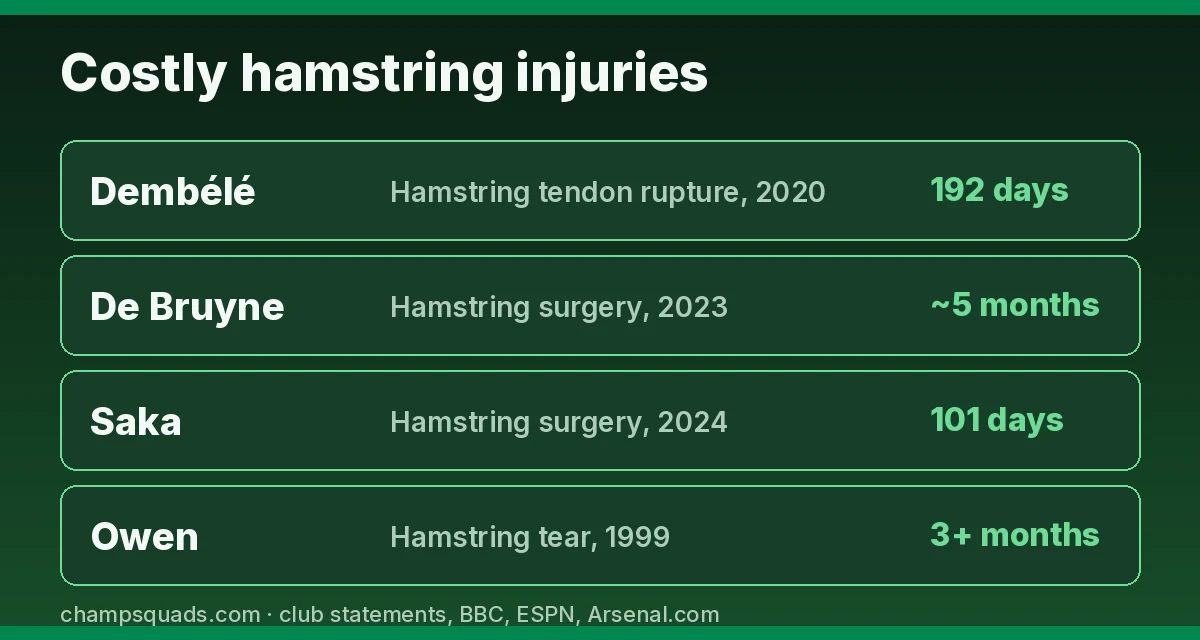
Michael Owen is the cautionary tale. He tore his hamstring at Leeds in April 1999, aged 19. Liverpool chose rehab rather than surgery. Owen later said the injury left his right hamstring permanently weaker, and recurring thigh problems followed. It shows why previous injury sits in the cause table.
Ousmane Dembélé broke down repeatedly at Barcelona before a complete hamstring tendon rupture in training in February 2020. He had surgery in Finland and was only cleared 192 days later, missing the rest of the season.
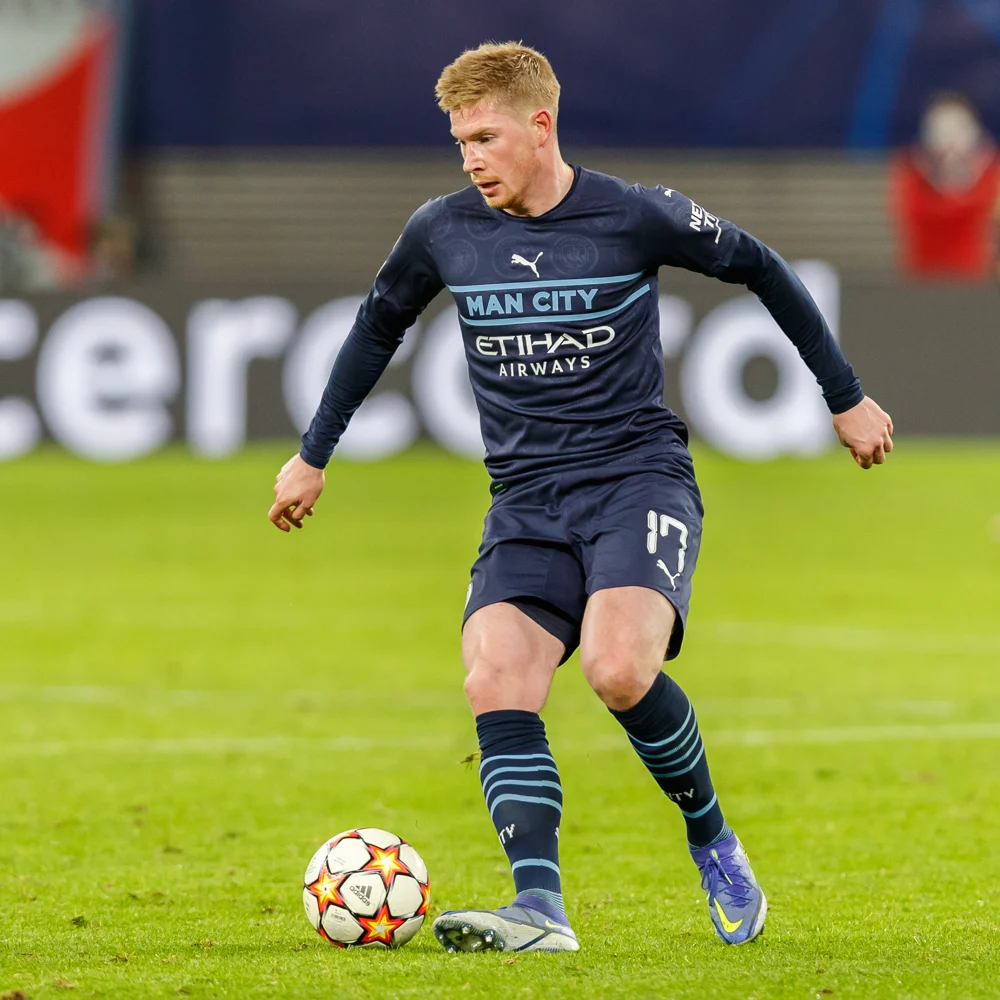
Kevin De Bruyne limped off in the 2023 Champions League final, then tore the same hamstring 23 minutes into Manchester City’s next league opener at Burnley. Surgery kept him out for almost five months. Our Man City match guide covers the current squad.
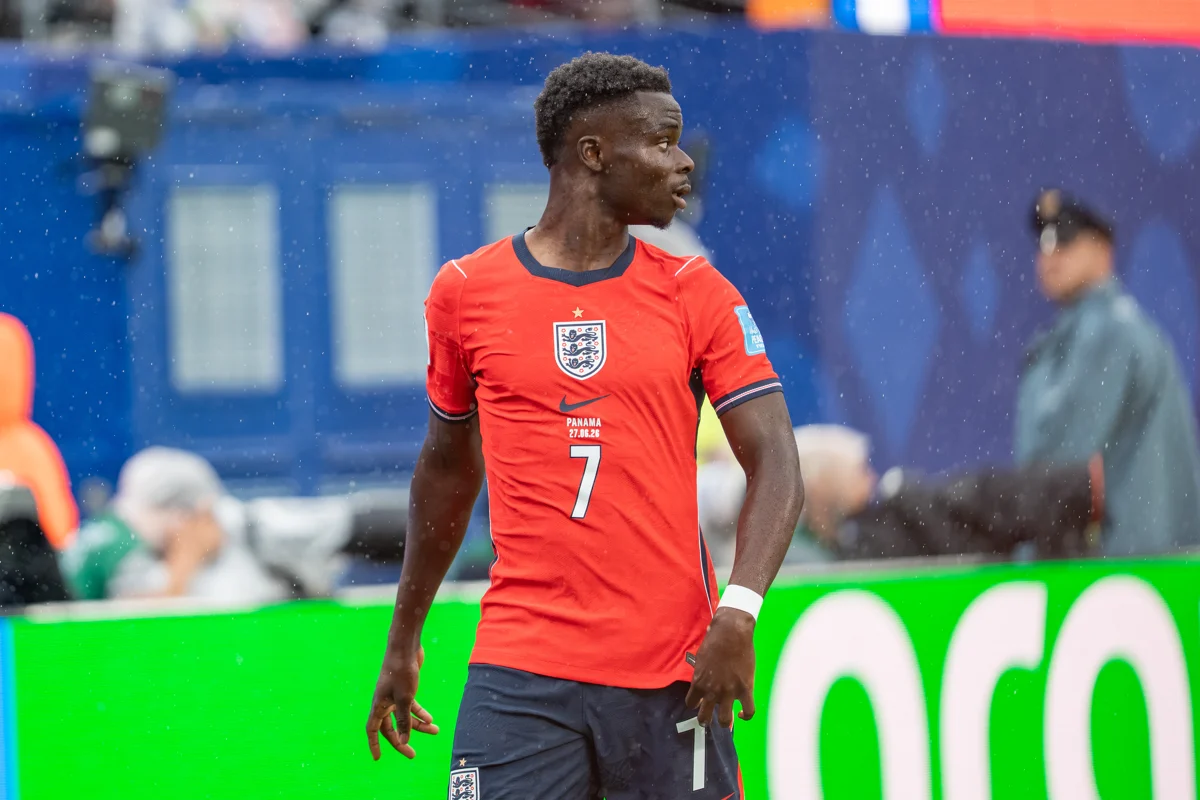
Bukayo Saka tore his right hamstring at Crystal Palace in December 2024 and needed surgery, missing 19 Arsenal matches before scoring on his return against Fulham on 1 April 2025. In October 2026 he went off early against Bayern with a left thigh problem and is still being assessed. More on Arsenal in our Arsenal trophies history.
Pulled muscle treatment and recovery basics
Muscle strain treatment at home usually starts with rest, ice wrapped in a cloth, compression and elevation for the first two or three days, then gentle movement as pain allows. There is no reliable way to heal a pulled muscle overnight. The honest answer to how to speed up muscle strain recovery is a gradual, guided return to loading, because rushing back is exactly what creates the “previous injury” risk in the table.
Health note: this article is general information, not a diagnosis. See a doctor or physiotherapist if you heard a pop, cannot walk or bear weight, have major swelling or bruising, or the pain is not improving after a few days.
Why muscle injuries matter for bettors
Muscle injuries are the most common reason players miss games, so they move team news and odds. A hamstring strain on a winger or striker can change goalscorer, handicap and over/under markets. Hamstring problems also recur, so a player “back in training” after a strain may start on the bench or play fewer minutes.
Before you bet, check our injury updates, scores and fixtures and football predictions. 8xbet suits this approach well, with early team-news markets, live in-play betting that lets you react once line-ups are confirmed, and regular promotions. Our 8xbet vs SportyBet vs Bet9ja comparison explains why. Barcelona fans can follow Olmo’s return in our Hansi Flick Barcelona guide, and Chelsea fans can track Lacroix in Chelsea news now.
18+ only. Betting carries risk, and you should never stake more than you can afford to lose. Set a budget, take breaks, and visit our responsible gambling page if betting stops being fun.
Last updated: 3 November 2026. Player injury details are taken from club statements and major outlets and can change quickly.
FAQ
What is the best medicine for a pulled muscle?
There is no single best medicine. For short-term pain, many people use paracetamol or an anti-inflammatory such as ibuprofen, often as a gel on the sore area. Anti-inflammatories are not suitable for everyone, for example some people with asthma, stomach ulcers or kidney problems, or during pregnancy, so ask a pharmacist or doctor first.
What foods help muscle recovery?
Protein-rich foods such as eggs, fish, chicken, beans and Greek yoghurt give muscles the building blocks they need to repair. Carbohydrates such as rice, oats and potatoes refill energy stores. Fruit and vegetables, including berries and leafy greens, add vitamins that support healing.
What to drink for muscle recovery?
Water is the basic choice for most people. After long or very sweaty sessions, an electrolyte drink can help replace lost salts, and milk or a protein shake adds protein and fluid together. Alcohol can slow recovery, so it is best kept to a minimum.
What is the most painful muscle to strain?
Pain varies from person to person, but severe hamstring tears near the hip, groin (adductor) strains and lower back strains are often described as among the most painful. They involve large muscles that are used in almost every step, so it is hard to rest them completely.