The rules and regulations of basketball are set internationally by FIBA, and the current edition is the FIBA Official Basketball Rules 2026, which took effect worldwide on 1 October 2026. Two teams of five players try to score by shooting the ball through the opponents’ basket while stopping the other team from scoring. The team with more points when time runs out wins.
This guide covers the basketball rules every player, student and bettor needs, the biggest change in years, how national basketball association (NBA) rules differ, and where to get the official rules and regulations of basketball PDF free. Every figure was checked on 26 October 2026 against FIBA’s and the NBA’s own rulebooks.

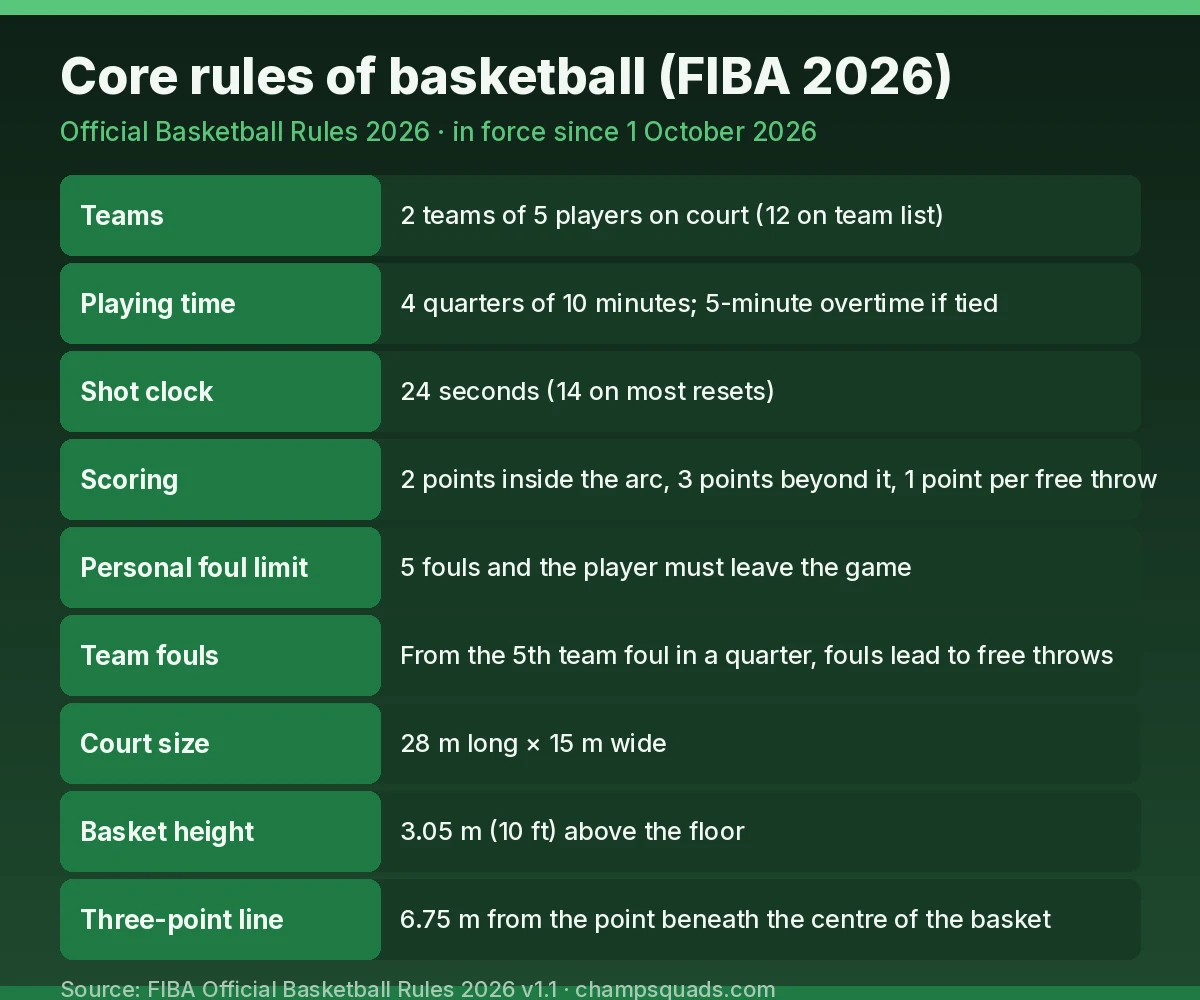
Rules and regulations of basketball at a glance (FIBA 2026)
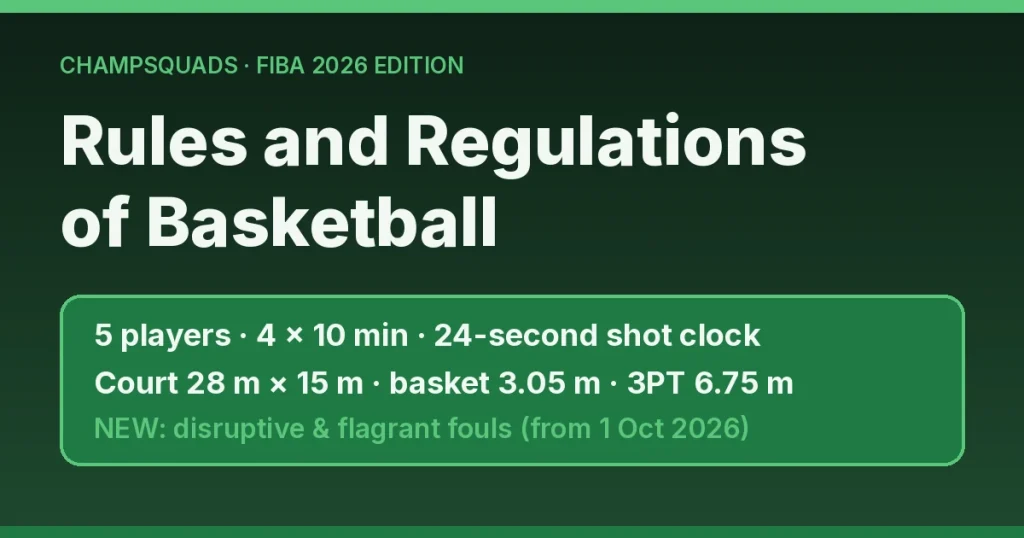
What are the rules and regulations of basketball? In short: five players per team, four 10-minute quarters, a 24-second shot clock, two or three points per basket, and disqualification after five personal fouls.
| Element | Official FIBA regulation (2026) |
|---|---|
| Teams | 2 teams of 5 players on court; up to 12 players on the team list |
| Playing time | 4 quarters of 10 minutes; 5-minute overtime if tied |
| Shot clock | 24 seconds; reset to 14 seconds after an offensive rebound in most cases |
| Scoring | 2 points inside the arc, 3 points beyond it, 1 point per free throw |
| Personal foul limit | 5 fouls and the player must leave the game |
| Team fouls | From the 5th team foul in a quarter, fouls lead to free throws |
| Court size | 28 m long × 15 m wide |
| Basket height | 3.05 m (10 ft) above the floor |
| Three-point line | 6.75 m from the point beneath the centre of the basket |
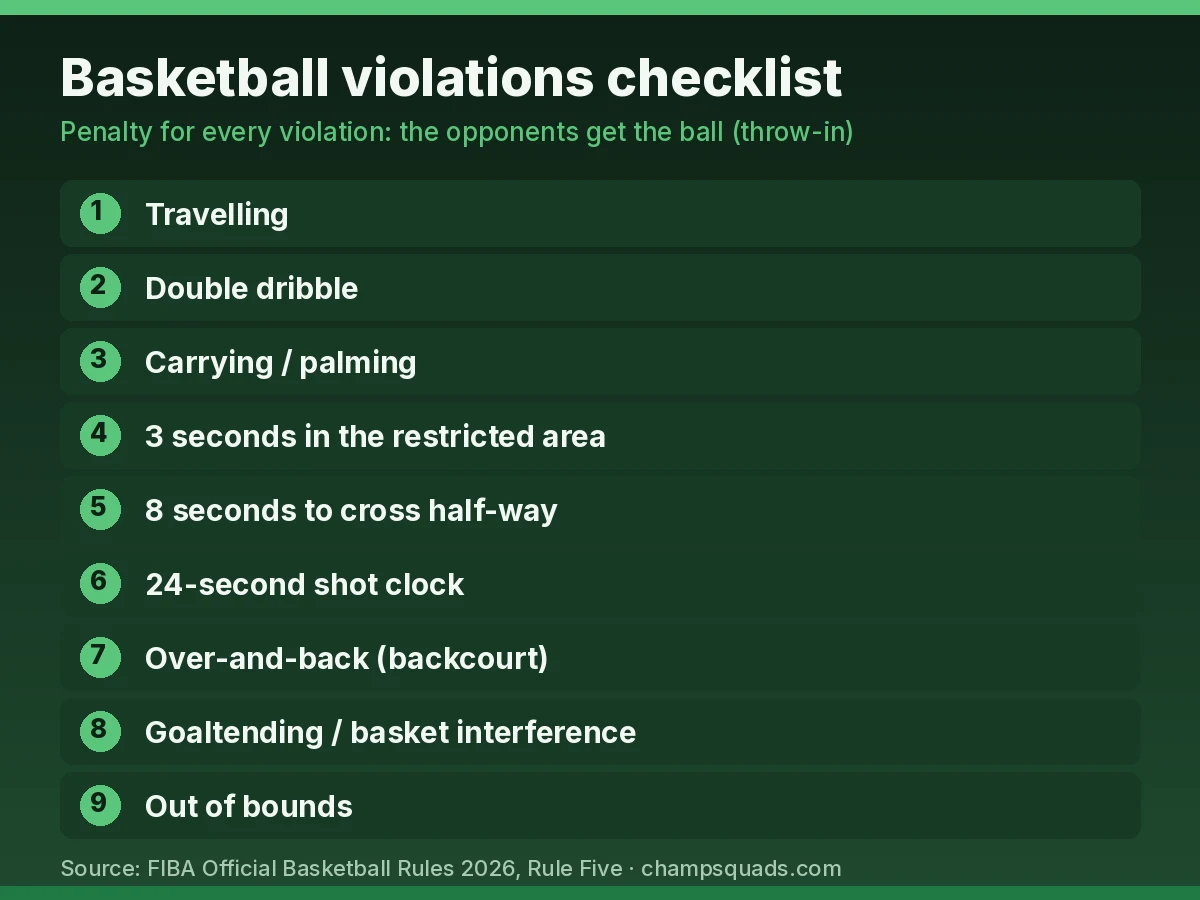
Main violations checklist
A violation is a rule breach without illegal contact. The other team gets the ball.
- Travelling: moving a foot illegally while holding the ball.
- Double dribble: dribbling again after ending a dribble, or dribbling with both hands at once.
- Carrying (palming): letting the ball rest in the hand while dribbling.
- 3 seconds: an attacker staying in the opponents’ restricted area for more than three seconds while their team controls the ball.
- 8 seconds: failing to bring the ball from the backcourt into the frontcourt within eight seconds.
- 24-second shot clock violation: failing to get a shot to touch the ring before the shot clock expires.
- Over-and-back: returning the ball to the backcourt once it has reached the frontcourt.
- Goaltending and basket interference: touching the ball on its downward flight to the basket, or touching the ring or net during a shot.
Latest FIBA rule update: disruptive and flagrant fouls
What changed on 1 October 2026?
- Unsportsmanlike foul removed: it has been replaced by two new fouls (Articles 37 and 38).
- Disruptive foul: illegal contact that stops play unfairly, such as a tactical foul to halt a fast break. It counts as a team foul but does not count towards game disqualification.
- Flagrant foul: reckless, violent, dangerous or excessive contact. It does count towards disqualification.
- Technical fouls split in two: one category counts towards disqualification and one does not (Article 36).
FIBA says the old system, where two unsportsmanlike or technical fouls (or one of each) sent a player off, was “overly strict”. The new split keeps disqualification for genuinely dangerous play. You can read the reasoning in FIBA’s 2026 rule changes summary and its official announcement.
Authority line: the information in this section is based on the FIBA Official Basketball Rules 2026 (version 1.1), valid as of 1 October 2026, and was last checked on 26 October 2026.
Basketball court dimensions and equipment
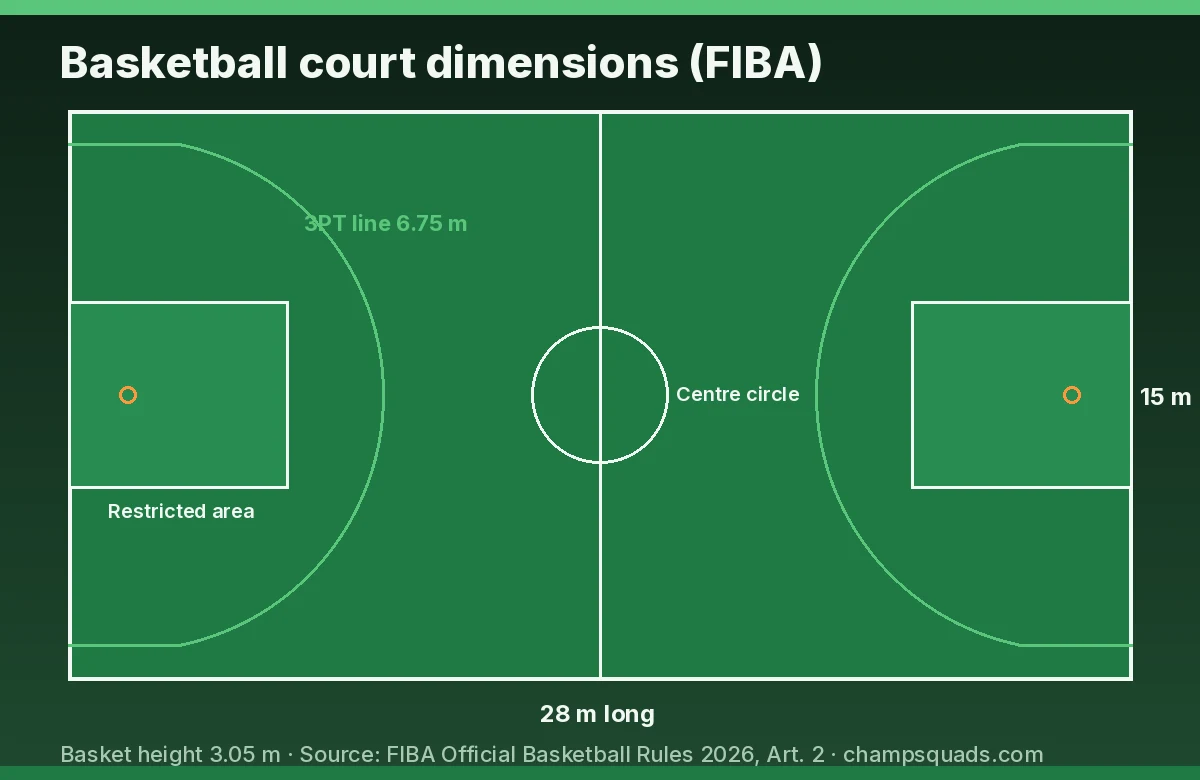
A FIBA court is a flat, hard rectangle 28 metres long and 15 metres wide, measured from the inner edge of the boundary lines. The three-point arc sits 6.75 metres from the point on the floor directly beneath the centre of the basket, and the ring stands 3.05 metres above the floor.
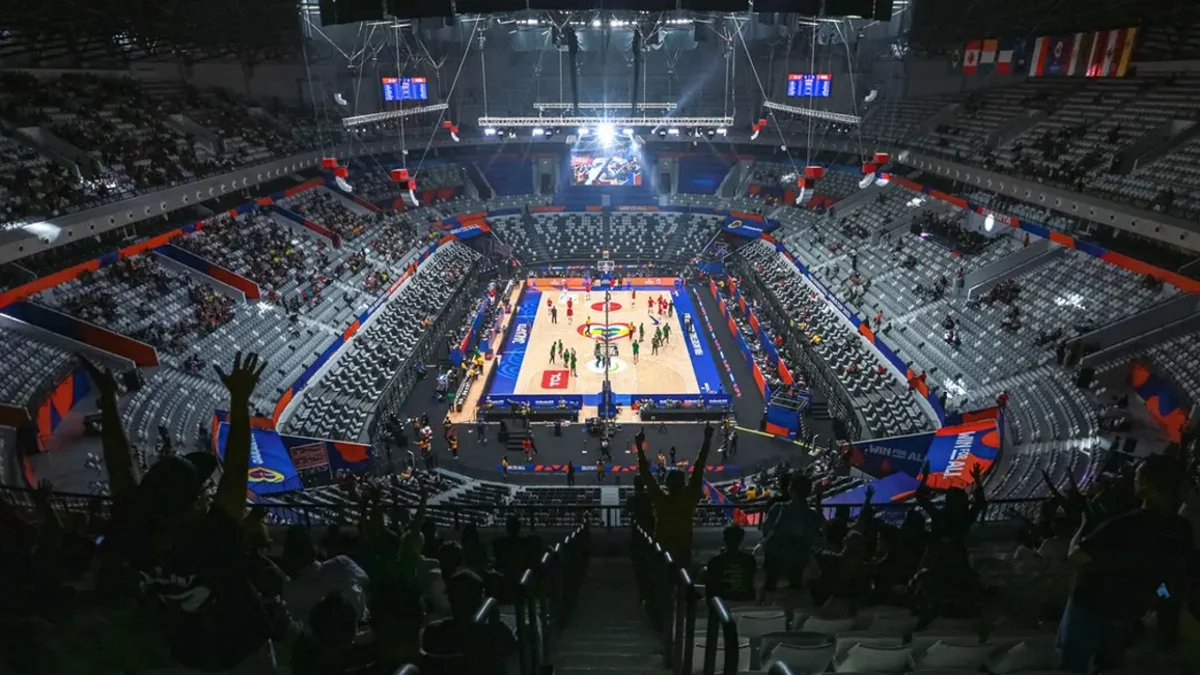
Basketball rules and fouls explained
A foul is illegal contact or unsporting behaviour. The main types:
- Personal foul: illegal contact such as holding, pushing, tripping, blocking or charging. A shooter who is fouled gets two or three free throws, or one extra if the shot goes in.
- Technical foul: a non-contact offence, such as disrespecting a referee or repeatedly faking being fouled after a warning. The opponents get one free throw.
- Disqualifying foul: flagrantly unsporting behaviour by a player or coach. The offender is sent off at once.
Team fouls matter too. Once a team has committed four team fouls in a quarter, every further player foul gives the opponents free throws, even when no shot was being taken.
FIBA vs NBA: how the national basketball association rules differ
Most fans meet the game through NBA basketball, the biggest professional league and the face of basketball in the USA. The basketball NBA fans watch differs slightly from the FIBA version used at the Olympics, the AfroBasket and in Nigeria’s leagues.
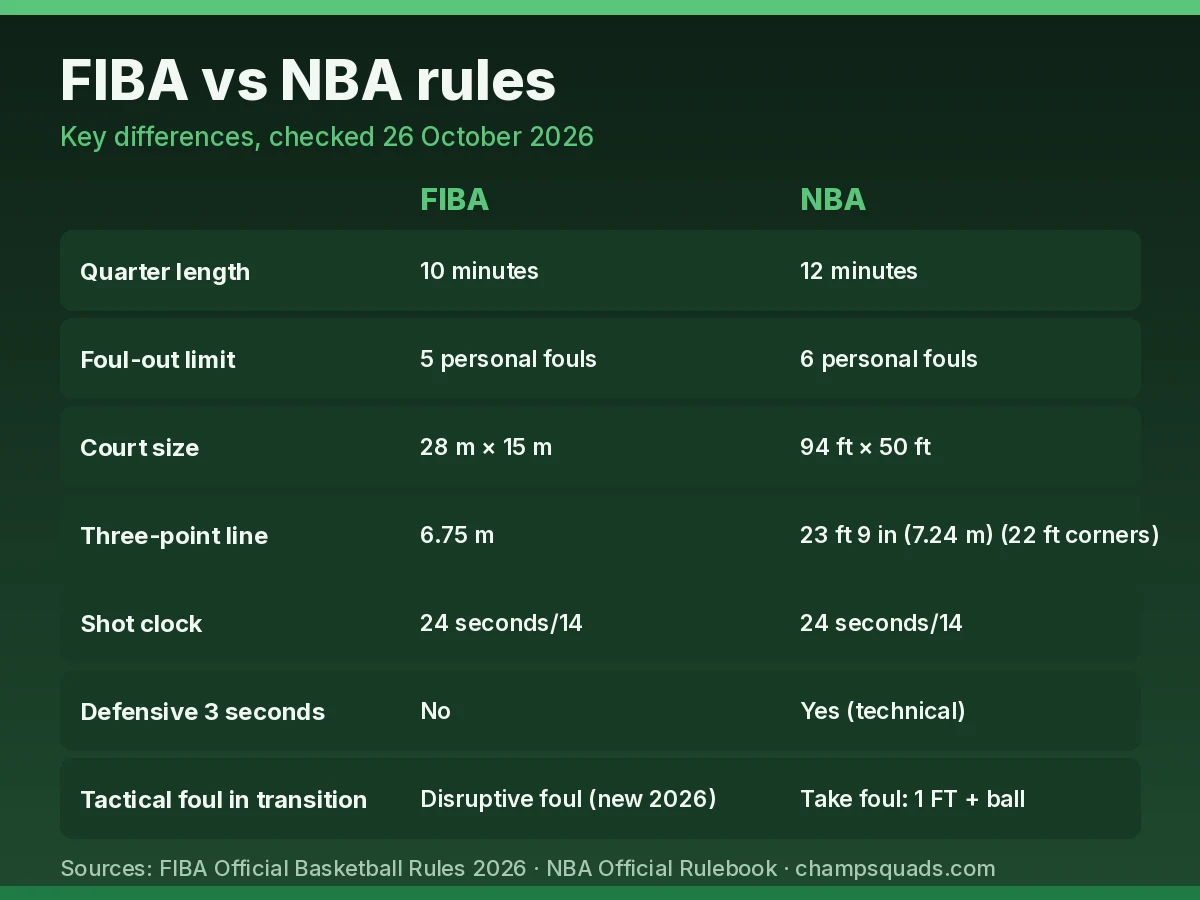
| Rule | FIBA (2026) | NBA |
|---|---|---|
| Quarter length | 10 minutes (40 in total) | 12 minutes (48 in total) |
| Foul-out limit | 5 personal fouls | 6 personal fouls |
| Court size | 28 m × 15 m | 94 ft × 50 ft (28.65 m × 15.24 m) |
| Three-point line | 6.75 m | 23 ft 9 in (7.24 m); 22 ft in the corners |
| Shot clock | 24 seconds (14 on resets) | 24 seconds (14 on resets) |
| Defensive 3 seconds | No | Yes, a technical foul |
| Tactical foul in transition | Disruptive foul (new in 2026) | Take foul: 1 free throw plus possession |
The NBA still uses Flagrant 1 and Flagrant 2 fouls, which the league office reviews after games, as in this example:
Lesson note on rules and regulations of basketball: 10 rules to learn first
Teachers often ask students to mention five rules and regulations of basketball, or 10. Here is a lesson-note version of the 10 rules of basketball:
- Each team has five players on court, and substitutes may come on when the ball is dead.
- The game starts with a jump between two opponents in the centre circle.
- Players move the ball by passing or dribbling. Running with it is travelling.
- After ending a dribble, a player cannot dribble again until another player touches the ball.
- A shot from inside the arc scores 2 points, from beyond it 3, and a free throw 1.
- The attacking team has 24 seconds to get a shot away.
- The ball must reach the frontcourt within 8 seconds and cannot then go back.
- Attackers cannot stay in the restricted area for more than 3 seconds.
- Illegal contact is a foul, and a player with 5 fouls must leave the game.
- If the score is tied after 40 minutes, teams play 5-minute overtimes until there is a winner.
For the 20 rules of basketball, add throw-ins, time-outs, substitutions, goaltending and team fouls from the PDF below. Items 1, 3, 5, 6 and 9 answer the classroom question: what are the 5 basic rules of basketball?
Rules and regulations of basketball PDF free download
FIBA publishes the full rulebook free, so skip unofficial copies:
- FIBA Official Basketball Rules 2026 (PDF, version 1.1): the full international rulebook, valid from 1 October 2026.
- FIBA Official Basketball Rules Changes 2026 (PDF): what changed and why, with the new rulebook text.
- NBA Official Rulebook: the national basketball association rules, organised by rule number.
A short history of basketball
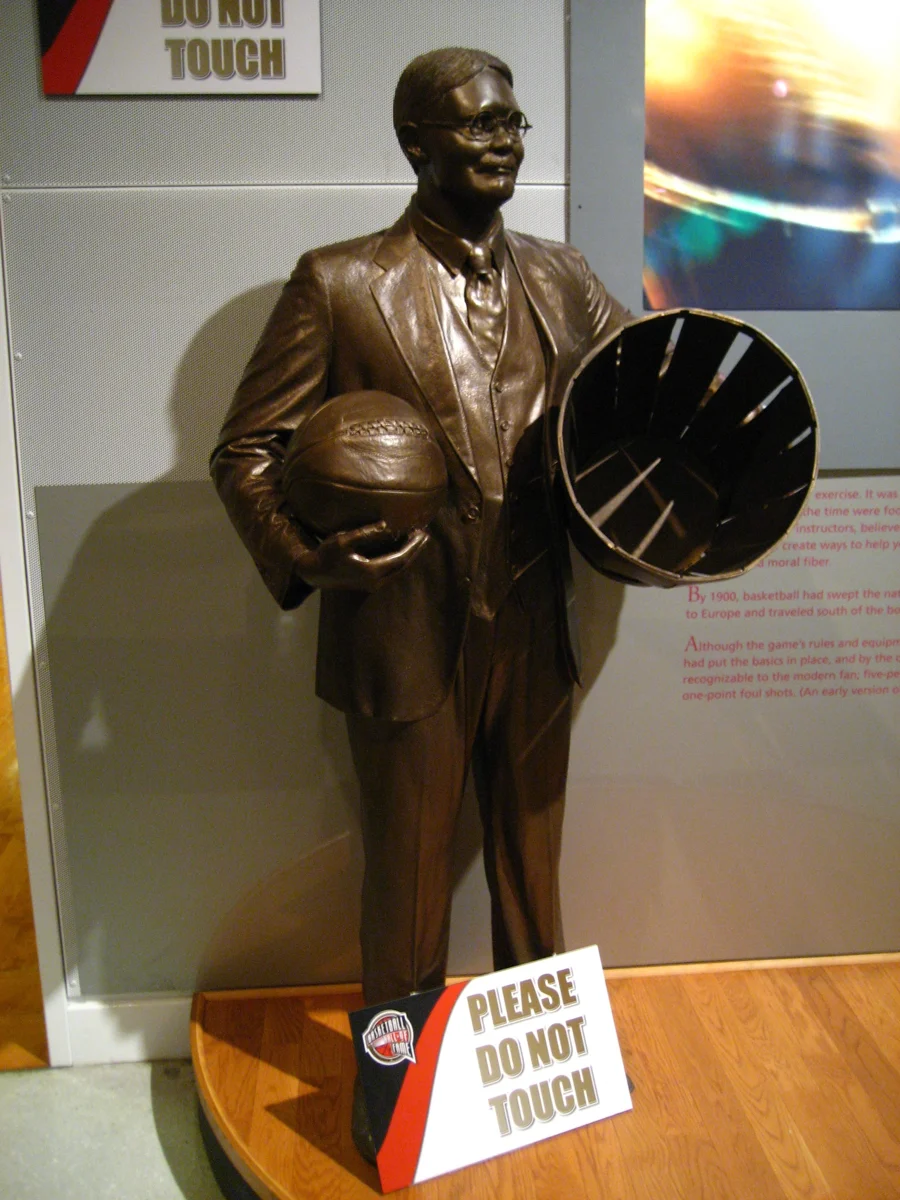
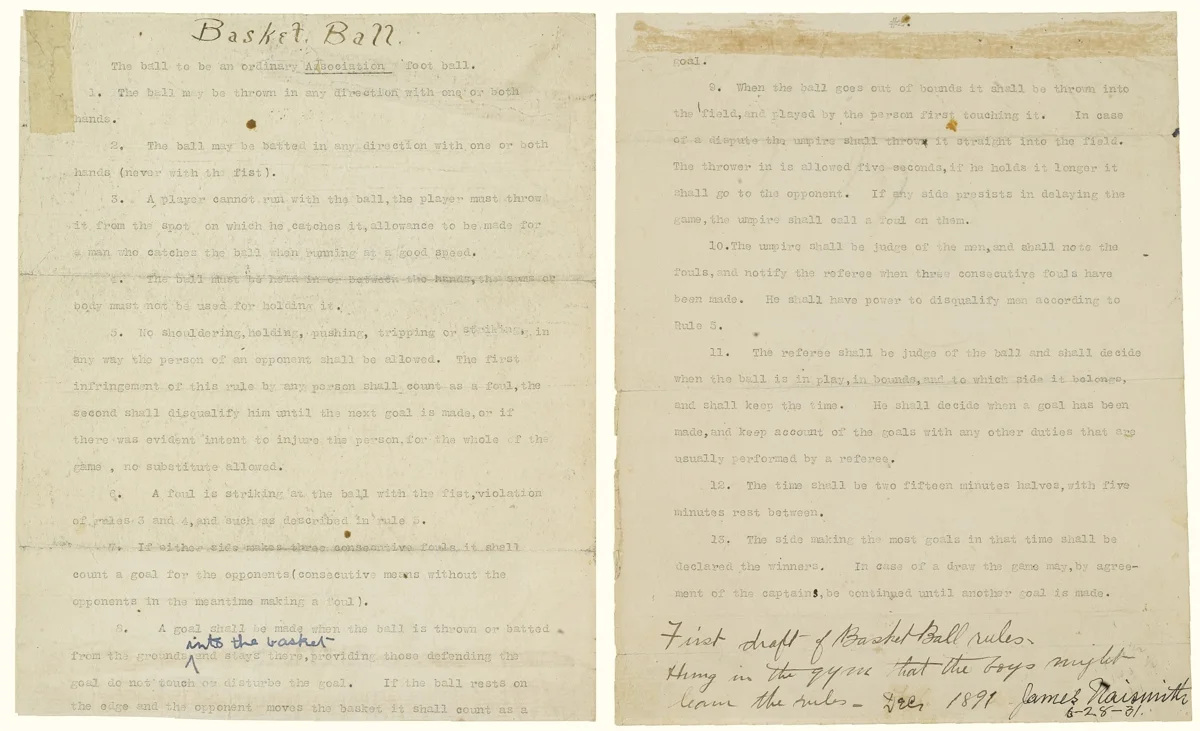
The history of basketball starts in December 1891 at the YMCA International Training School in Springfield, Massachusetts. Instructor James Naismith needed an indoor winter game, so he nailed two peach baskets to the gallery rail. The first game ended 1-0.
FIBA was founded in Geneva in 1932, and basketball made its Olympic debut in Berlin in 1936. The Basketball Association of America was founded in 1946 and became the NBA in 1949. Today FIBA sets the rules used in more than 200 countries.
Basketball vs volleyball rules: a quick comparison
Volleyball was also invented at a Massachusetts YMCA, but the rules of volleyball are very different:
| Rule | Basketball (FIBA) | Volleyball (FIVB) |
|---|---|---|
| Players on court | 5 per team | 6 per team |
| How to win | Most points after 40 minutes | Best of five sets; sets to 25 points |
| Contact with opponents | Limited, and fouls are penalised | None: a net separates the teams |
| Handling the ball | Dribble, pass or shoot | Up to 3 touches per side; no catching |
Betting on basketball with 8xbet
Knowing the basketball rules gives you an edge when betting. Foul trouble and shorter FIBA quarters change totals. 8xbet is our pick for basketball betting in Nigeria. It covers the NBA, the EuroLeague and FIBA tournaments, with live betting on quarter totals and player points. Our basketball prediction tips shows how to read form and pace, and our best betting site in Nigeria guide explains why we rate 8xbet above the local bookmakers. See also the 8xbet vs SportyBet comparison.
18+ only. Champsquads is for adults of legal betting age in Nigeria. Betting carries real financial risk, and predictions are opinions, never guarantees. Set a budget, take breaks and never stake money you cannot afford to lose. Read our responsible gambling guide and affiliate disclosure: we may earn a commission if you sign up through our links.
More: our Nigeria basketball team guide, weekly sports predictions, the basketball, guides and news sections, our scores and fixtures page, injury updates and the Champsquads homepage.
Last updated: Monday 26 October 2026. We will update this guide whenever FIBA or the NBA changes the rules.
FAQ
Why is number 69 not allowed in basketball?
No rulebook bans it outright, but the NBA has never approved 69 because of its sexual connotation. When Dennis Rodman asked to wear it for the Dallas Mavericks in 2000, commissioner David Stern vetoed the request, so Rodman wore 70 instead. FIBA allows 0, 00 and 1 to 99, but organisers can still refuse an offensive number.
What is rule 12 in basketball?
It depends on the rulebook. In the NBA rulebook, Rule 12 is “Fouls and Penalties”, covering technical fouls, personal fouls, flagrant fouls and free-throw penalty situations. In the FIBA rulebook, Article 12 covers the jump ball and the alternating possession arrow used for later held-ball situations.
How many rules are there for basketball?
The FIBA Official Basketball Rules 2026 are organised into eight Rules split into 51 Articles, plus appendices on referee signals, the scoresheet and instant replay. James Naismith’s original 1891 game had just 13 rules.
What is the 5 rule in basketball?
It usually means the five-second closely guarded rule. Under FIBA Article 27, a player holding the ball who is closely guarded by an opponent within one metre must pass, shoot or dribble within 5 seconds, or the team loses possession. A player also has 5 seconds to release a throw-in.